Amana Colonies: The Handcrafted Escape

The Amana Colonies Story

Submitted by matt on Fri, 2006-07-14 18:54.

The Amana story is unlike any other in American history.

In turbulent 18th century Germany in the midst of a religious movement called Pietism, two men, Eberhard L. Gruber and Johann F. Rock, advocated faith renewal through reflection, prayer and Bible study. Their belief, one shared by many other Pietists, was that God, through the Holy Spirit, may inspire individuals to speak. This gift of inspiration was the basis for a religious group that began meeting in 1714 and became known as the Community of True Inspiration. Though the Inspirationists sought to avoid conflict, they were persecuted for their beliefs. Eventually the Inspirationists found refuge in central Germany settling in several estates, including the 13th century Ronneburg castle.

Seeking Freedom

Photo by Bertha Shambaugh - Amana circa 1900Persecution and an economic depression in Germany forced the community to begin searching for a new home. Led by Christian Metz, they hoped to find religious freedom in America and left Germany in 1843-44. Community members pooled their resources and purchased some 5,000 acres near Buffalo, New York where, by working cooperatively and sharing their property, the community, now numbering some 1,200 people, was able to carve a relatively comfortable living. They called their community the Ebenezer Society and adopted a constitution that formalized their communal way of life.

When more farmland was needed for the growing community, the Inspirationists looked to Iowa where attractively priced land was available. One valley on the Iowa River seemed particularly promising. Here was fertile soil, stone, wood and water enough to build the community of their dreams.

Remaining True

In 1855 they arrived in Iowa. After an inspired testimony commanded the people to call their village, "Bleibtreu" or "remain faithful," the leaders chose the name Amana from the Song of Solomon 4:8. Amana means to remain true. Six villages were established, a mile or two apart, across a river valley tract of some 25,000 acres - Amana, East Amana, West Amana, South Amana, High Amana and Middle Amana. The village of Homestead was added in 1861, giving the Colonies access to the railroad.

The Amana Colonies would become one of America's longest-lived and largest religious communal society.

In the seven villages, residents received a home, medical care, meals, all household necessities and schooling for their children. Property and resources were shared. Men and women were assigned jobs by their village council of brethren. No one received a wage. No one needed one.

Farming and the production of wool and calico supported the community, but village enterprises, everything from clock making to brewing, were vital, and well-crafted products became a hallmark of the Amanas. Craftsmen took special pride in their work as a testament of both their faith and their community spirit. The Amana villages became well known for their high quality goods.

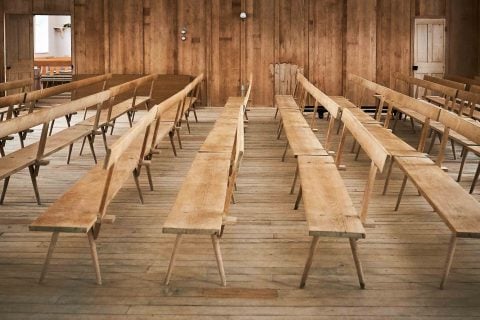
Up before dawn, called to work by the gentle tolling of the bell in the village tower, the unhurried routine of life in old Amana was paced very differently than today. Amana churches, located in the center of each village, built of brick or stone, have no stained glass windows, no steeple or spire, and reflect the ethos of simplicity and humility. Inspirationists attended worship services 11 times a week; their quiet worship punctuating the days.

Over 50 communal kitchens provided three meals daily to Colonists. These kitchens were operated by the women of the Colony and well supplied by the village smokehouse, bakery, ice house and dairy and by huge gardens, orchards and vineyards maintained by the villagers.

Children attended school six days a week year-round until the age of 14. Boys were assigned jobs on the farm or in the craft shops, while girls were assigned to a communal kitchen or garden. A few boys were sent to college for training as teachers, doctors and dentists.

In 1932, amidst America's Great Depression, Amana set aside its communal way of life. A ruinous farm market and changes in the rural economy contributed, but what finally propelled the change was a strong desire on the part of residents to maintain their community. By 1932, the communal way of life was seen as a barrier to achieving individual goals, so rather than leave or watch their children leave, they changed. They established the Amana Society, Inc., a profit-sharing corporation, to manage the farmland, the mills and the larger enterprises. Private enterprise was encouraged. The Amana Church was maintained.

Today the seven villages of the Amana Colonies represent an American dream come true; a thriving community founded by religious faith and community spirit. Declared

a National Historic Landmark in 1965, the Amana Colonies attract hundreds of thousands of visitors annually, all of whom come to see and enjoy a place where the past is cherished and where hospitality is a way of life.

Evocative of another age, the streets of the Amana Colonies with brick, stone and clapboard homes, flower and vegetable gardens, lanterns and walkways, recall Amana yesterday. Our community today is vibrant, celebrating both its past and its future, here today for you to experience.

Amana Heritage Society

The Amana Heritage Society maintains seven historical sites. Single admission or multi-site admissions are available. For more information on Amana Heritage Sites and to check their calendar of special events and programs phone 319-622-3567 or visit www.amanaheritage.org.


Amana Heritage Sites

Amana Community Church Museum
319-622-3567
amherit@juno.com
www.amanaheritage.org

Whether you want to learn more about Amana or simply wish to experience a setting uniquely suited to reflection, visit the 1865 Saal (church or meetinghouse) in Homestead. Guides discuss religious beliefs and practices of the Amana Church, while explaining the unique history and architecture of this 140-year-old church. Open Saturdays, May - October, 10am - 5pm. Open Monday - Friday, June 15 - August 14, 11am - 5pm.

Amana Heritage Museum
319-622-3567
amherit@juno.com
www.amanaheritage.org

One of your first stops should be the Amana Heritage Museum. With an award-winning, 20-minute video, exhibits in three communal era buildings and grounds recalling turn of the century Amana life, the museum tells Amana's story from 18th century Germany to the present. The Amana Heritage Museum is among Iowa's top historical attractions. Special programs and exhibits. Museum store. Open daily April 1 - October 31; 10am - 5pm Monday - Saturday, noon - 4pm Sunday. Open Saturdays in March, November and December.

Communal Agriculture Museum
319-622-3567
amherit@juno.com
www.amanaheritage.org

Built in 1858, the South Amana barn housing the Communal Agriculture Museum is one of the oldest in the seven colonies. Tools, implements and photographs from Amana's communal era depict operations on the nation's largest communal farm. Open Saturdays, May 23 - Sept 5, 10am - 5pm

Communal Kitchen & Cooper Shop
319-622-3567
amherit@juno.com
www.amanaheritage.org

Preserved just as it was on the day in 1932 when the last communal meal was served in the Colony, visiting the Communal Kitchen and Cooper Shop is like stepping back in time. Guides explain kitchen routines and share insights on communal Amana life. Popular with all ages, the Communal Kitchen and Cooper Shop is an Amana historical treasure. Open Saturdays, May - October, 10am - 5pm. Open Monday - Friday, June 15 - August 14, 11am - 5pm.

 High Amana General Store
319-622-3232
www.amanaheritage.org

This museum-operated, original 1858 village store looks much as it did 100 years ago and offers a variety of merchandise. Open daily April - October and Saturdays in March, November, & December.

Homestead Blacksmith Shop
319-622-3567
amherit@juno.com
www.amanaheritage.org

Experience the sights, sounds and smells of the original village blacksmith shop. Also on site is a traditional print shop with operating Linotype and hand-set printing press. Blacksmith, printing and bookbinding demonstrations. Open Saturdays, May 23 - September 5, 11am - 4pm.

Homestead Store Museum
319-622-3567
amherit@juno.com
www.amanaheritage.org

Commerce sustained communal Amana, and its importance is explored at this historical site in Homestead. Craft and industry, plus an examination of the community's relationship with the "outside world," are depicted. View storage of museum artifacts and display of Colony buildings in miniature make the Homestead Store well worth discovering. Open Saturdays, May - October, 10am - 5pm. Open Monday - Friday, June 15 - August 14, 11am - 5pm.

© 2009 Amana Colonies Convention & Visitors Bureau
Site by JEO.NET